
The 2026 American Heart Association/American Stroke Association guideline for adult stroke rehabilitation and recovery is useful because it frames stroke recovery as more than a short period of physical therapy after hospital treatment. It describes rehabilitation as a coordinated, ongoing process that may need to address movement, cognition, communication, mood, activity, participation, family support, and the transition from hospital to home.
For cognitive rehabilitation, that matters. Many stroke survivors leave hospital with difficulties that are not always visible: attention, memory, planning, sequencing, orientation, problem-solving, fatigue, confidence, and the ability to manage everyday routines. The guideline is a reminder that these needs should sit inside mainstream rehabilitation planning, not at the edge of it.
This article is not a substitute for the guideline or local clinical judgement. It is a practical reading of the themes most relevant to cognitive stroke rehabilitation and digital rehabilitation tools.
Rehabilitation starts early, but it does not end quickly
The AHA/ASA newsroom summary says rehabilitation should begin once a person is medically stable, ideally within 48 hours of stroke. It also notes that moderate- to high-intensity exercise and task practice should not be performed in the first 24 hours after stroke.
The bigger point is that rehabilitation should not be treated as a single early episode. The guideline describes recovery as a process that can continue for months or years, with periodic reassessment and re-engagement in therapy where new needs or decline are identified.
For services, this supports pathway thinking. A patient may need different rehabilitation inputs in hospital, after discharge, in the community, and at home. Cognitive recovery may also change over time as fatigue, mood, confidence, communication, home routines, and family support change.
Cognition belongs in the main rehabilitation conversation
The guideline highlights physical, cognitive, language, and mental health needs. That is important because cognitive changes can shape whether a person can use physical improvements in real life.
A person may be physically able to stand at a kitchen counter but still struggle to remember the next step in making a drink. They may be able to walk around a shop but struggle to scan shelves, filter distractions, handle choices, or sequence the task. They may have enough strength to dress but still find initiation, attention, or problem-solving difficult.
Good rehabilitation planning therefore needs to ask practical questions. What does the person need to do? Which cognitive skills are getting in the way? What support, adaptation, repetition, or strategy might help? How will progress be reviewed?
Task practice and intensity are recurring themes
The guideline’s top take-home messages emphasise sufficient amounts and intensity of task practice after the earliest acute period. That does not mean every person should simply do more of everything. It means therapy should have enough dose, structure, and relevance to change function, while remaining clinically appropriate and paced.
For cognitive rehabilitation, task practice should not be reduced to abstract puzzles. Everyday activities can be rich cognitive tasks. Preparing a snack, finding items, sorting objects, following a route, checking a list, or completing a shopping task may involve attention, working memory, visual scanning, sequencing, inhibition, error recognition, and judgement.
The most useful activities are often the ones that make clinical reasoning visible: where did the person pause, what did they miss, how did they respond to prompts, what changed when the task had more steps, and what happened when distractions were added?
Technology is most useful when it supports clinical reasoning
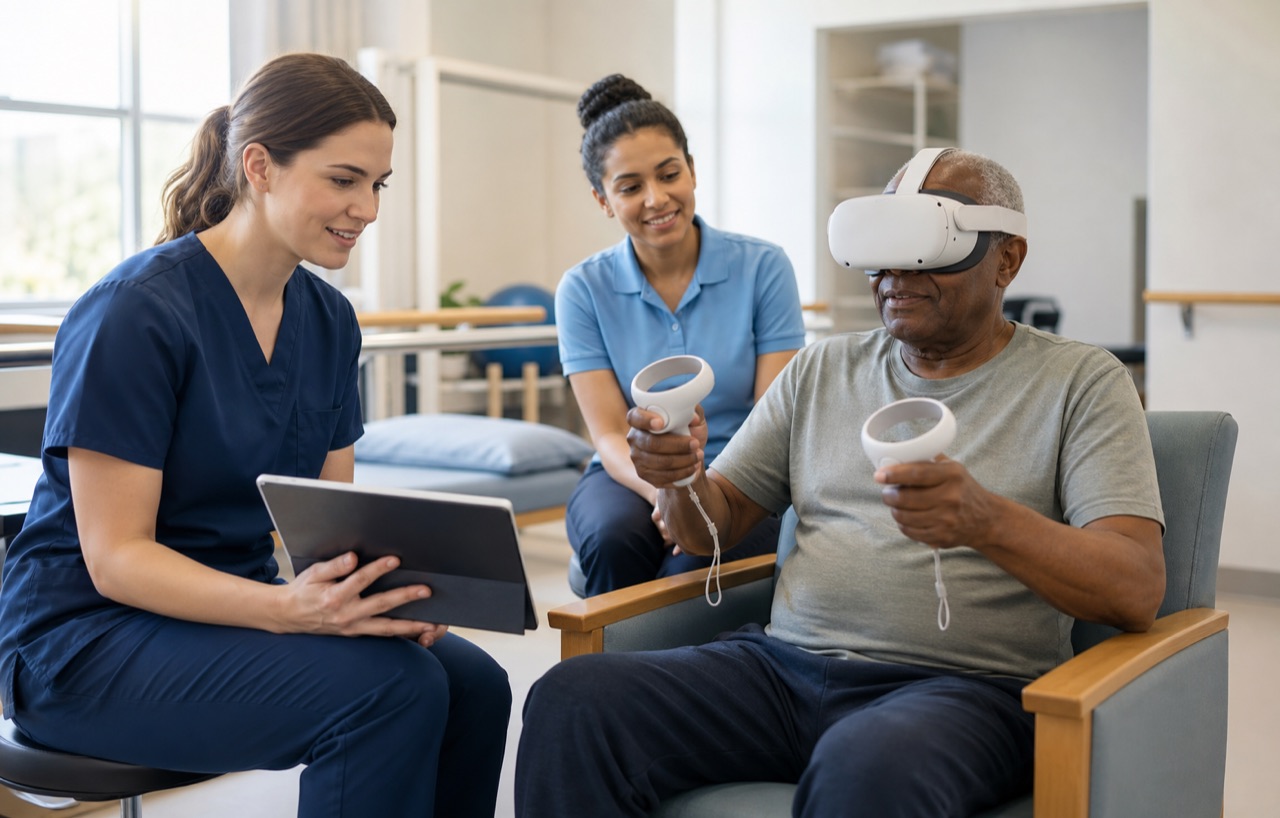
The guideline includes a specific recommendation for supervised, moderate- to high-intensity technology-supported cognitive training programs that are tailored and adaptive to performance for people with post-stroke cognitive impairments.
That is not the same as saying any app, headset, game, or digital tool is automatically useful. The clinical value depends on the design and the pathway around it.
Useful technology should help clinicians choose an appropriate activity, adjust difficulty, supervise safely, review progress, understand patient experience, and connect practice to everyday goals. It should also make support, governance, and escalation clear.
The guideline does not endorse CorteXR Stroke or any other individual product. If your service is considering technology-supported cognitive rehabilitation, use the questions it raises during review: is the training supervised, tailored, adaptive, sufficiently structured, relevant to real function, and reviewable over time?
Home and community rehabilitation are central
The guideline gives clear attention to transitions after discharge. It recommends ongoing community- or home-based rehabilitation after recent stroke when feasible to achieve functional goals. It also describes home-based multidisciplinary rehabilitation as a reasonable alternative to clinic-based rehabilitation for people living at home after stroke, including goals related to self-care and cognitive or communicative function.
This matters for cognitive rehabilitation because many cognitive difficulties become most visible at home. A ward or clinic can show one part of performance. Daily life shows another: managing routines, coping with distractions, preparing food, remembering instructions, tolerating fatigue, or balancing confidence with safety.
Services should think about how cognitive practice, caregiver education, patient support, and outcome review continue beyond the inpatient stay.
Care partners need support too
The guideline emphasises education and training for care partners. This is practical, not decorative. Families and helpers often become part of the rehabilitation environment, especially after discharge.
For cognitive recovery, families may need help understanding why a person can do one task on one day and struggle the next. They may need guidance on prompts, fatigue, safety, frustration, and how to support independence without taking over. They may also need support for their own wellbeing.
Digital rehabilitation tools used at home should be designed with this reality in mind. Instructions, videos, troubleshooting, and escalation routes are not just technical support. They are part of making the pathway usable.
The useful takeaway
The 2026 AHA/ASA guideline supports a broad, clinically governed view of rehabilitation: start early when safe, personalise care, use multidisciplinary input, address cognition and mental health, support families, measure progress, and keep rehabilitation connected across settings.
For cognitive rehabilitation services, the opportunity is to make therapy more functional, more repeatable, more measurable, and easier to continue beyond hospital while keeping clinical judgement at the centre.
Useful references
- AHA newsroom: Stroke rehab should start early and address physical, cognitive and mental health
- 2026 AHA/ASA guideline in Stroke: Adult Stroke Rehabilitation and Recovery
- Guideline Central: AHA/ASA Adult Stroke Rehabilitation and Recovery pocket guide
Medical note: This resource is for general information and service planning. Stroke survivors and families should follow advice from their own clinical team.