
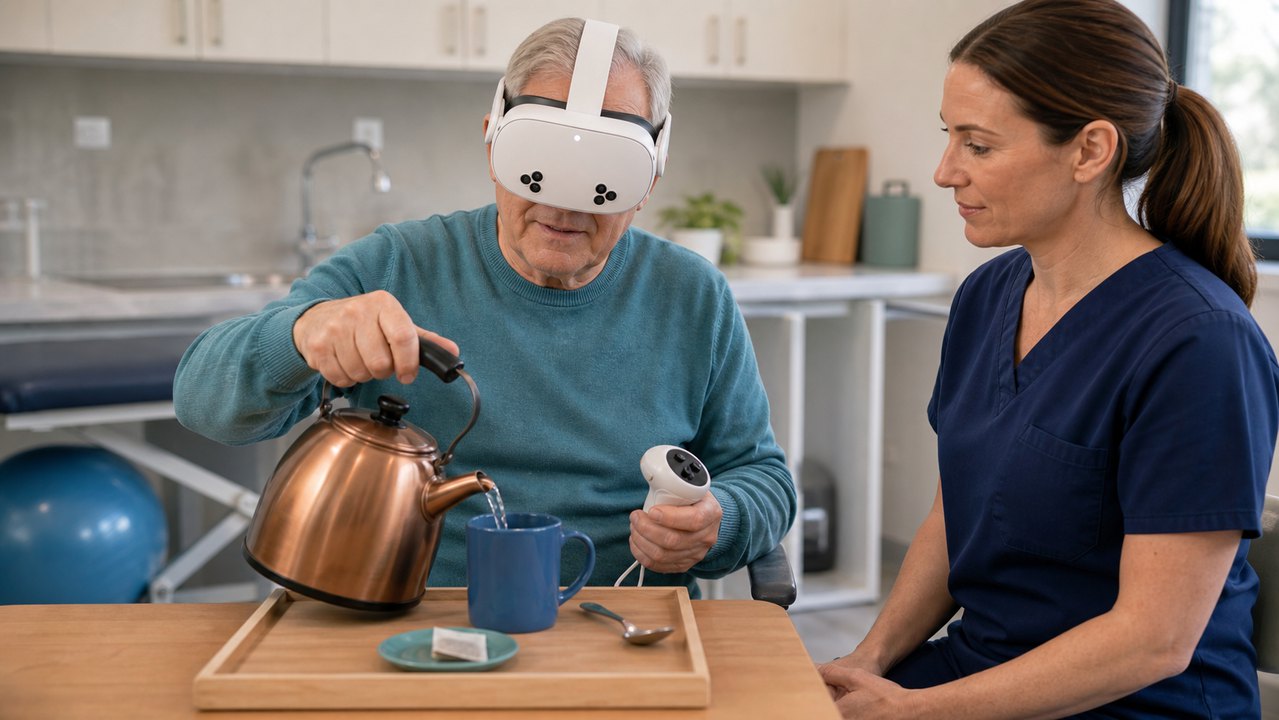
The 2026 AHA/ASA adult stroke rehabilitation and recovery guideline includes a recommendation that is especially relevant for occupational therapists and cognitive rehabilitation teams: for people with stroke and cognitive impairments, rehabilitation that incorporates cognitively focused and contextually relevant daily-life activities is reasonable for improving global cognition, working memory, and executive functions.
That phrase may sound technical, but the idea is practical. Cognitive rehabilitation should connect with the activities people are trying to get back to.
Why everyday tasks are cognitively rich
Activities of daily living are not simple. Making tea, preparing lunch, shopping, dressing, finding household items, or organising medication can involve many cognitive skills at once.
A routine task may require a person to understand the goal, remember the next step, scan the environment, choose the relevant object, ignore distractions, sequence actions, notice mistakes, solve small problems, keep going despite fatigue, and stop safely when something is wrong.
After stroke, any one of these steps may become harder. That is why a person can look physically capable but still find everyday routines exhausting, slow, risky, or frustrating.
Cognitive rehabilitation is more than abstract exercises
Paper-based activities and computer tasks can have a place. They may help isolate a specific skill or give a simple way to practise attention, memory, or reasoning. But daily life rarely isolates one skill at a time.
Contextually relevant rehabilitation asks a different question: how does cognition affect the person’s real activities?
This is where everyday tasks become clinically useful. A therapist can observe how the person plans, scans, starts, remembers, adapts, and checks. The goal is not simply to complete an exercise. The goal is to understand and improve participation in daily life.
How clinicians can grade daily-life activities
Daily-life activities can be adjusted without losing their meaning. A clinician might simplify a tea-making task to a small number of objects, then later add more steps, distractors, choices, or a time element. A shopping task might begin with finding one item and progress towards choosing several items from a list.
Useful grading may involve fewer or more objects, shorter or longer sequences, simple or competing instructions, visible or hidden cues, low or high visual complexity, predictable or changing task demands, more or fewer prompts, or shorter or longer sessions.
The art is to keep the task meaningful while making the challenge appropriate.
Why VR can support this kind of practice
Immersive VR can simulate daily-life activities in a controlled environment. That can be useful when a real kitchen, shop, or busy home environment is not available, practical, or safe for repeated use.
The advantage is not that VR is flashy. The advantage is that it can make functional practice repeatable, graded, and reviewable. A patient can practise a task more than once. A clinician can adjust the demands. The team can review what happened and connect the virtual task back to real-world goals.
For example, a virtual kitchen activity may help the therapist observe sequencing, object recognition, visual scanning, response to prompts, and tolerance of cognitive load. A virtual shopping task may bring together attention, memory, search, choice, and inhibition.
What services should avoid
There is a risk that daily-life language becomes vague. Not every simulated activity is automatically good cognitive rehabilitation. The clinical design needs to be clear.
Services should avoid activities that look realistic but do not target a clear rehabilitation need, are too complex to interpret clinically, cannot be graded, cannot be reviewed, overload the patient, have no connection to real goals, or leave families unsure what the activity is for.
The question should always be: what are we trying to learn, practise, or progress?
Where CorteXR Stroke fits
CorteXR Stroke uses immersive Activities of Daily Living practice for cognitive stroke rehabilitation. Its relevance to the guideline is the design choice to focus on functional, everyday tasks rather than abstract VR experiences.
That does not mean the guideline endorses CorteXR Stroke. It means the product sits in a space the guideline recognises as clinically meaningful: cognitively focused, contextually relevant activity practice, supervised and configured by clinicians.
The stronger the link between the activity, the patient’s goals, the difficulty setting, and the review process, the more useful this kind of technology can become.
The useful takeaway
Daily-life activities are not just a friendlier way to present rehabilitation. They are where cognition becomes visible.
The 2026 AHA/ASA guidance supports the idea that cognitive rehabilitation should connect to meaningful functional activity. For clinicians and service leads, that points towards rehabilitation tools and pathways that make everyday task practice safe, graded, repeatable, and clinically reviewable.
Useful references
- 2026 AHA/ASA guideline in Stroke: Adult Stroke Rehabilitation and Recovery
- Guideline Central: AHA/ASA Adult Stroke Rehabilitation and Recovery pocket guide
- AHA newsroom: Stroke rehab should start early and address physical, cognitive and mental health
Medical note: This resource is for general information and service planning. Stroke survivors and families should follow advice from their own clinical team.