
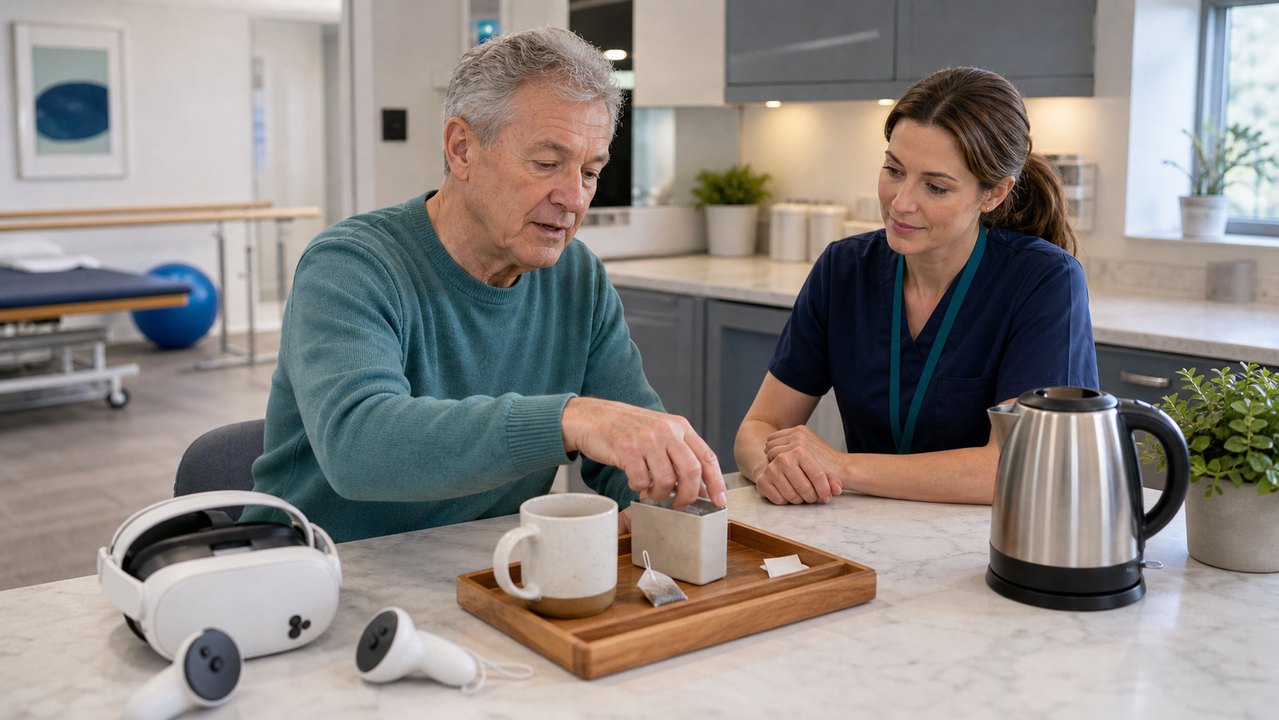
A useful cognitive rehabilitation goal might be making breakfast, following a shopping list or managing a familiar routine. These goals give patients, families and clinicians something concrete to discuss when choosing activities and reviewing progress.
Canada’s 2025 stroke rehabilitation recommendations put personalised goals and participation at the centre of cognitive rehabilitation. Part Three of the seventh edition covers activity and community participation; its journal article appeared online in November 2025 and in the March 2026 issue. It is a Canadian guideline, with useful questions for teams elsewhere to consider alongside their own national guidance. Read the published guideline.
What the cognitive rehabilitation recommendations say
The recommendations call for cognitive screening and assessment, shared planning with the person and their family, and plans that are reviewed as needs change. They distinguish compensation, such as prompts or environmental changes, from training directed at a particular cognitive skill. Both can be used within an individual plan.
Therapist-guided computer training may be considered for selected executive function, attention and working-memory difficulties. Commercial brain games are excluded from these recommendations because evidence of everyday functional benefit remains limited. The guideline also says VR may be considered, but its efficacy for post-stroke cognitive impairment is not established. Several recommendations carry low-quality evidence ratings; recommendation strength should not be read as certainty about benefit. See Section 3 and its clinical considerations.
Turn a broad goal into an observable activity
The following examples are practical ways to frame a discussion with a therapist, rather than protocols specified by the Canadian guideline.
| Everyday goal | A question to explore in a supervised activity | A review point |
|---|---|---|
| Prepare a familiar drink | Where does the person pause, repeat a step or ask for help? | Record which step needed support and what prompt was used. |
| Find items for a small shop | Does the person refer to the list, search systematically and check the basket? | Discuss missed items and the person’s checking strategy. |
| Organise objects for an outing | How does the person decide what is needed and check that it is ready? | Compare the plan with what was selected. |
For a worked activity, see making a cup of tea after stroke. Our shopping task guide explores a different set of choices, distractions and checking demands.
Keep the strategy visible during practice
Consider a hypothetical person who wants to prepare a drink but loses their place halfway through. A therapist might explore a visible sequence card, a different arrangement of objects or practice focused on a particular step, according to their assessment.
The useful record would describe what happened: which step was missed, whether the person checked the card and how much help was needed. A completion score alone would leave those questions unanswered. If the activity changes at the next session, record that too, so the comparison remains understandable.
Our guide to functional cognition after stroke explains how everyday task performance can inform these conversations. For a specific difficulty, explore attention problems or planning and sequencing after stroke.
Questions to ask about a digital activity
When reviewing software, ask the supplier to demonstrate an actual activity and walk through a specific use case:
- Which part of the person’s goal does the activity address?
- What can the clinician change, and what support is available during use?
- Which task events are recorded, and what do those records mean?
- How will the team check whether anything learned is useful outside the software?
An improvement within a repeated digital task does not, by itself, demonstrate a change in independent daily living. Product evaluation needs to distinguish the activity’s design, usability and clinical outcome evidence. Our VR cognitive rehabilitation overview and clinical governance guide develop those questions.
Continue the conversation beyond hospital
Before a digital activity goes home, the team can agree who sets it up, who reviews it and how the person or helper asks for support. A short handover describing the everyday goal, current activity and next review can make responsibilities easier to follow. See our community stroke rehabilitation guide for a practical checklist.
CorteXR Stroke provides immersive everyday activities for cognitive stroke rehabilitation. The Canadian guideline does not endorse CorteXR; services should review its clinical evidence and intended use separately. For another national perspective, read our AHA/ASA technology-supported cognitive training article.
Sources
- Canadian Stroke Best Practices, Section 3: Cognitive Rehabilitation for Individuals with Stroke
- Part Three: Optimizing Activity and Community Participation Following Stroke, seventh edition update 2025
Medical note: This resource is for general information and service planning. Stroke survivors and families should follow advice from their own clinical team.